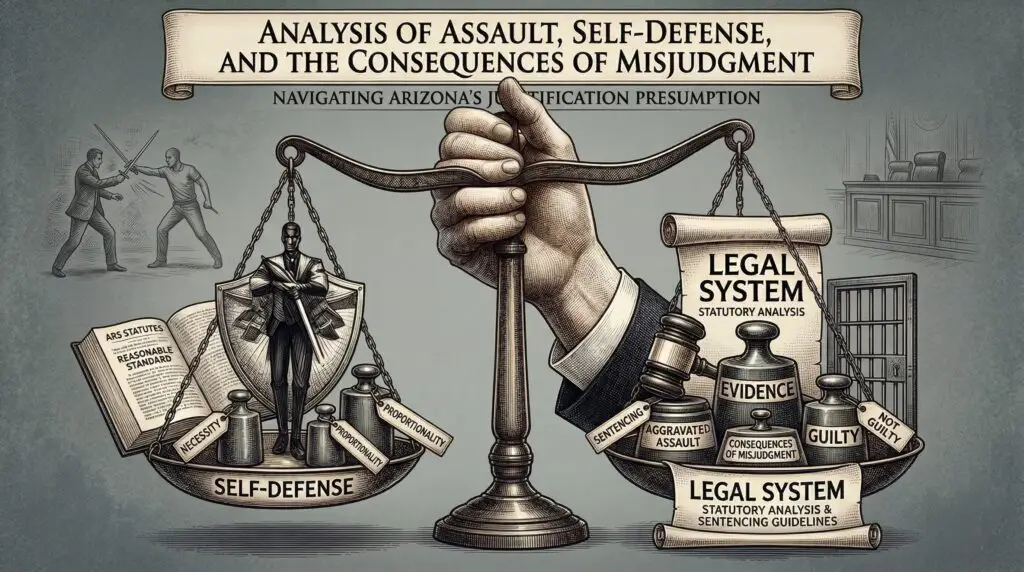
Justified Force in Arizona: A Focused Analysis of Assault, Self-Defense, and the Consequences of Misjudgment
Educational Video: This comprehensive legal analysis is based on the following video:
Important Legal Disclaimer: This article is for educational purposes only and is not legal advice. Firearm laws are complex and can change. Always consult a licensed attorney for your specific situation.
👉 Prefer the short version? If you want a faster, plain-English overview of Arizona’s self-defense laws for CCW holders, see our Arizona Self-Defense Law: A Plain-English Guide for CCW Holders. This page is the comprehensive legal analysis with case citations and the full sentencing table.
Section 1: The Foundation of Justified Force in Arizona
The legal framework governing self-defense in Arizona is built upon a precise and hierarchical set of statutes. These laws dictate the specific circumstances under which an individual is justified in using physical force against another, establishing a clear line between a lawful act of self-preservation and a criminal assault. Understanding this statutory foundation is the essential first step for any citizen seeking to comprehend their rights and, more critically, their legal limitations. The law provides separate but interconnected justifications for the use of general physical force and the use of deadly physical force, with the latter being contingent upon the former.
1.1 The Justification of Physical Force: A.R.S. § 13-404
The cornerstone of Arizona’s self-defense law is Arizona Revised Statute (A.R.S.) § 13-404. This statute provides the baseline justification for using non-deadly physical force. It states: “a person is justified in threatening or using physical force against another when and to the extent a reasonable person would believe that physical force is immediately necessary to protect himself against the other’s use or attempted use of unlawful physical force”.1 The application of this statute hinges on the interpretation of several key terms:
- “Reasonable Person”: This establishes an objective standard. The jury or fact-finder is not asked to determine if the defendant subjectively felt fear, but whether an ordinary, prudent person, placed in the exact same circumstances and possessing the same information, would have believed force was necessary.2 This standard is designed to prevent justifications based on irrational fears or hypersensitivity.
- “Immediately Necessary”: The threat must be imminent and presently occurring. Force cannot be used to retaliate for a past attack or to preempt a future, speculative threat. The response must be a direct reaction to an ongoing or impending unlawful act.2
- “Unlawful Physical Force”: The force being defended against must itself be illegal. One cannot, for example, claim self-defense against a lawful use of force by a peace officer.
Crucially, A.R.S. § 13-404(B) also enumerates specific situations where the use of physical force is explicitly not justified. These limitations are absolute and serve as initial gatekeepers for any self-defense claim:
- In Response to Verbal Provocation Alone: No amount of insults, taunts, or offensive language can legally justify a physical response. The law draws a bright line between words and actions.1
- To Resist Arrest: An individual may not use force to resist an arrest they know or should know is being made by a peace officer, regardless of whether the arrest is lawful or unlawful. The only exception is if the officer uses physical force that exceeds what is legally permissible.1
- If the Person is the Initial Aggressor: The person who starts a physical confrontation forfeits their right to claim self-defense. This right can only be regained if the initial aggressor unequivocally withdraws from the encounter or communicates their intent to do so, and the other party nevertheless continues the attack.1
1.2 The Justification of Deadly Physical Force: A.R.S. § 13-405
The legal standard for using deadly physical force is significantly higher and is governed by A.R.S. § 13-405. This statute builds directly upon the foundation of § 13-404, creating a two-part test that must be met for the use of deadly force to be justified:
- The person must first be justified in using some level of physical force under the standards of A.R.S. § 13-404.9
- A reasonable person must believe that deadly physical force is immediately necessary to protect against the other’s use or attempted use of unlawful deadly physical force.2
This statutory structure creates a mandatory, sequential logic for legal analysis. A jury cannot even begin to consider whether the use of deadly force was a proportional response to a deadly threat until it has first concluded that the defendant had the right to use any force at all. If the defendant’s justification fails at the first step—for example, because they responded to mere words or were the initial aggressor—their right to use force is legally extinguished. In such a case, any subsequent inquiry into the proportionality of the force they used becomes legally irrelevant. This sequential failure is a common and devastating pitfall for defendants who focus only on the final, life-threatening moments of an encounter, failing to recognize that their right to self-defense was already forfeited by their prior actions.
A defining feature of Arizona’s self-defense law is its “Stand Your Ground” provision, codified in A.R.S. § 13-405(B). This subsection explicitly states that a person has “no duty to retreat” before using deadly physical force, provided they are in a place where they have a legal right to be and are not engaged in an unlawful act.2 This means an individual facing a deadly threat in a public park, their place of business, or their home is not legally required to attempt an escape before defending themselves.
However, a significant and potentially perilous disconnect exists between this statutory right and the practical realities of a courtroom. While the law does not require retreat, a prosecutor will almost invariably argue that a “reasonable person” would have retreated if a safe avenue was available. The decision to remain and use force, when leaving was an option, can be framed as unreasonable, aggressive, or even indicative of a willingness to engage in combat.5 This creates a precarious situation for the defendant: while they may have a legal
right not to retreat, the act of exercising that right can be used by the prosecution to undermine the core “reasonableness” of their actions in the minds of the jury. Therefore, from a legal risk management perspective, the safest course of action is often to retreat if a safe opportunity exists, even though it is not statutorily mandated.
Section 2: The “Reasonable Person” Standard: An Objective Legal Test
The concept of the “reasonable person” is the fulcrum upon which every self-defense claim in Arizona balances. It is the objective, impartial standard against which a defendant’s perceptions, beliefs, and actions are measured. Understanding how this standard functions, and how it interacts with the burden of proof in a criminal trial, is critical to appreciating the legal gauntlet a defendant must navigate.
2.1 Defining the Objective Standard
The justification statutes repeatedly hinge on what a “reasonable person” would have believed or done in the same situation.1 This is a deliberate legal construction designed to create an
objective test, not a subjective one. The jury is not instructed to step into the defendant’s mind and evaluate their personal fears or anxieties. Instead, they are tasked with evaluating the totality of the circumstances—the aggressor’s actions, words, size, the location, the time of day—and determining whether a typical, ordinary, and prudent person would have perceived an imminent threat and responded with a similar level of force.3
The Arizona Supreme Court has affirmed this objective standard, notably in cases like State v. King, which clarified that the focus is on the objective reasonableness of the defendant’s belief, not their unique psychological state.11 This means that a defendant’s past trauma or heightened sense of fear, while personally real, is not the legal standard. The question remains: would an average member of the community, facing the same external stimuli, have reached the same conclusion about the necessity and proportionality of the defensive force used?
This creates a paradox within the justice system. While the “reasonable person” standard is legally defined as an objective measure, it is ultimately applied by a jury of individuals, each with their own subjective life experiences, biases, and preconceived notions of what constitutes “reasonable” behavior. A juror who has never faced violence may have a vastly different perspective on what is a reasonable response to a threat than a juror with a background in law enforcement or the military. Consequently, the outcome of a self-defense case can become highly unpredictable, potentially hinging as much on the composition of the jury and the persuasive power of the attorneys’ narratives as on a purely objective application of the law.
2.2 The Burden of Proof: A Critical Shift
In a criminal trial, the prosecution bears the burden of proving the defendant’s guilt beyond a reasonable doubt. However, when a defendant claims self-defense, a unique procedural shift occurs. Self-defense is classified as an “affirmative defense”.5 This does not mean the defendant must prove they acted in self-defense. Rather, the defense is only required to present “some credible evidence” to support the claim and thereby “raise the defense”.7 This is a relatively low evidentiary bar. It can be met through the defendant’s own testimony, the testimony of a witness, or physical evidence suggesting a struggle.7
Once this threshold is met, the legal burden shifts dramatically. The prosecution must now prove, beyond a reasonable doubt, that the defendant’s actions were not justified.5 This is a formidable task. The State must effectively disprove a negative, convincing a jury that the defendant was not acting in reasonable self-defense. This procedural advantage for the defense has been consistently upheld by Arizona courts, as in the case of
State v. Duarte, which affirmed that the defendant need only present some evidence to trigger this shift.7
The strategic importance of this mechanism cannot be overstated. By successfully raising the defense, the entire legal posture of the trial is transformed. The prosecution is no longer simply proving the elements of assault; it is now saddled with the much more complex and difficult task of negating the defendant’s justification. A defense attorney’s primary initial goal is therefore to ensure enough evidence is presented to the court to secure a jury instruction on self-defense. Achieving this forces the prosecution to fight on two fronts, significantly increasing the difficulty of securing a conviction.
Section 3: The Presumption of Reasonableness: A Powerful Legal Shield
Beyond the standard justification statutes, Arizona law provides an even stronger protection for individuals who use force to prevent the commission of certain serious, violent crimes. A.R.S. § 13-411 not only justifies the use of deadly force in these scenarios but also creates a powerful legal presumption that the defender acted reasonably, fundamentally altering the starting point for a jury’s analysis.
3.2 The Power of the Presumption
The most potent element of this statute is found in subsection C: “A person is presumed to be acting reasonably for the purposes of this section if the person is acting to prevent what the person reasonably believes is the imminent or actual commission of any of the offenses listed in subsection A of this section”.12
This is a profound legal shield. In a standard self-defense case under § 13-404, the jury begins with a neutral stance and evaluates the evidence to determine if the defendant’s actions were reasonable. Under § 13-411, the jury is legally instructed to begin their deliberations with the assumption that the defendant’s use of force was reasonable.13 The burden then falls entirely on the prosecution to introduce evidence sufficient to rebut or overcome this presumption.13
The inclusion of “Aggravated Assault” in the list of predicate crimes creates a unique, reflexive legal dynamic. A person charged with Aggravated Assault for using force can simultaneously claim that their actions were justified to prevent the aggressor from committing Aggravated Assault against them. If the evidence suggests the defendant reasonably believed they were facing an imminent threat of serious physical injury or an attack with a deadly weapon (which would constitute aggravated assault), then the defendant’s own use of force—even deadly force—is presumed reasonable by law. This creates a powerful legal loop where the very crime the defendant is accused of becomes the foundation for their legal justification.
This presumption fundamentally shifts the strategic focus of a defense case. The primary objective becomes defining the aggressor’s actions as one of the enumerated felonies, rather than solely defending the client’s reaction. For instance, if an attacker breaks down a door, the defense will frame the act not as a simple trespass but as an attempted Burglary to gain the presumption. If an aggressor drags a victim during a fight, the act will be framed as attempted Kidnapping. This trial strategy forces the prosecution into a difficult position. They must not only prove their case against the defendant but also simultaneously defend the victim’s actions and disprove that the victim was in the process of committing a separate, serious felony. This complicates the prosecution’s narrative and significantly increases their evidentiary burden.
Section 4: Understanding the Charges: From Misdemeanor Assault to Felony Aggravated Assault
To fully grasp the potential pitfalls of a failed self-defense claim, one must first understand the criminal charges that could be filed. In Arizona, a physical altercation can result in charges ranging from a low-level misdemeanor to a life-altering felony. The distinction often hinges not on the defendant’s intent, but on the specific circumstances of the act and, most importantly, the severity of the resulting injury.
4.1 Misdemeanor Assault: A.R.S. § 13-1203
Simple assault, governed by A.R.S. § 13-1203, is a misdemeanor offense. A person can commit this crime in one of three ways:
- Causing Physical Injury: This involves intentionally, knowingly, or recklessly causing any “physical injury,” which is broadly defined as any impairment of physical condition.14
- Creating Apprehension of Injury: This occurs when a person intentionally places another in “reasonable apprehension of imminent physical injury.” No physical contact is required; an act like raising a fist in a threatening manner can suffice if the victim reasonably believes an attack is imminent.14
- Provocative Touching: This involves knowingly touching another person with the specific intent to injure, insult, or provoke them. The touch does not need to be violent or cause pain; an offensive or unwanted touch intended to antagonize can meet this definition.14
The law further classifies these misdemeanors based on the actor’s mental state and the specific act:
- Class 1 Misdemeanor: The most serious, for intentionally or knowingly causing a physical injury.14
- Class 2 Misdemeanor: For recklessly causing a physical injury or for intentionally creating apprehension of injury.14
- Class 3 Misdemeanor: The least serious, for knowingly touching with intent to injure, insult, or provoke.14
4.2 Felony Aggravated Assault: A.R.S. § 13-1204
An assault charge escalates from a misdemeanor to a felony when the underlying act of assault is accompanied by one or more statutory “aggravating factors”.18 A.R.S. § 13-1204 provides an extensive list of these factors, effectively creating a legal tripwire that can turn a simple fight into a serious felony case. The most common factors relevant to physical altercations include:
- Causing “Serious Physical Injury”: If an assault results in a “serious physical injury,” it is elevated to a Class 3 felony.21 This term has a specific legal definition that will be explored in detail in Section 6.
- Use of a “Deadly Weapon or Dangerous Instrument”: Using a deadly weapon (like a firearm or knife) or a “dangerous instrument” during the assault elevates it to a Class 3 felony.21 A dangerous instrument is broadly defined as anything that, under the circumstances of its use, is readily capable of causing death or serious physical injury. This can include common objects like a baseball bat, a heavy rock, a tire iron, or even a vehicle.18
- Causing a Fracture or Substantial Disfigurement/Impairment: Even if an injury does not meet the high bar of “serious physical injury,” an assault that causes a “temporary but substantial disfigurement,” “temporary but substantial loss or impairment of any body organ or part,” or a “fracture of any body part” is elevated to a Class 4 felony.21
- Assaulting a Protected Person: The statute designates a long list of protected individuals. Committing even a minor assault against one of these individuals while they are performing their official duties can result in a felony charge. This list includes peace officers, firefighters, paramedics, teachers on school grounds, healthcare workers, prosecutors, and public defenders.18
Section 5: The Pitfalls of a Failed Justification: Criminal Penalties and Lifelong Consequences
When a self-defense claim fails in court, the individual is no longer viewed as a defender but as a criminal assailant. The consequences of this failed justification are severe and are dictated by Arizona’s sentencing guidelines. The distinction between a misdemeanor and a felony conviction represents a legal and practical cliff, with the latter carrying life-altering penalties that extend far beyond incarceration.
5.1 Misdemeanor Sentencing
For misdemeanor assault convictions, the penalties, while serious, are significantly less severe than for felonies. The sentences are served in county jail rather than state prison, and probation is a common outcome for first-time offenders. The statutory maximums are set by A.R.S. § 13-707:
Class 3 Misdemeanor: Up to 30 days in jail and a fine of up to $500 plus surcharges.
Class 2 Misdemeanor: Up to 4 months in jail and a fine of up to $750 plus surcharges.
Class 1 Misdemeanor: Up to 6 months in jail and a fine of up to $2,500 plus surcharges.
5.2 Felony Sentencing: The Life-Altering Consequences
A conviction for aggravated assault is a felony, and the penalties are drastically more severe, with sentences served in the Arizona Department of Corrections. Arizona employs a structured sentencing scheme that establishes a “presumptive” prison term for each class of felony, which a judge can then increase or decrease based on aggravating or mitigating factors in the case.29
The following table illustrates the sentencing ranges for a first-time offender convicted of a non-dangerous felony assault, providing a stark visual comparison of the “sentencing cliff” between misdemeanor and felony convictions.
Offense Classification | Crime Example(s) | Presumptive Sentence | Potential Prison Range |
Class 3 Misdemeanor | N/A | ||
Class 2 Misdemeanor | N/A | ||
Class 1 Misdemeanor | N/A | ||
Class 6 Felony | Assault on a teacher (no injury) | 0.33 to 2 years | |
Class 5 Felony | 0.5 to 2.5 years | ||
Class 4 Felony | Assault causing fracture/temp. disfigurement | 1 to 3.75 years | |
Class 3 Felony | Assault causing serious physical injury | 2 to 8.75 years | |
Class 2 Felony | Assault on officer causing serious injury | 3 to 12.5 years |
Note: Sentencing data is derived from Arizona’s felony sentencing charts for first-time, non-dangerous offenses.18
The transition from the most serious misdemeanor (Class 1) to the least serious felony (Class 6) represents a fundamental change in the nature of punishment. A Class 1 Misdemeanor conviction carries a maximum of six months in a county jail.28 In contrast, a Class 6 Felony, the lowest felony level, carries a presumptive sentence of one year in the state prison system.31 This is not merely an increase in time; it is a shift to a much harsher, more structured, and more dangerous correctional environment.
Furthermore, the consequences of a felony conviction are permanent. Beyond any prison sentence, a convicted felon in Arizona loses significant civil rights, including the right to vote and the right to own or possess a firearm. A felony record creates immense and often insurmountable barriers to obtaining employment, securing housing, and pursuing professional licenses, effectively creating a permanent underclass status.32 This is the ultimate pitfall of a failed justification defense: the transformation from a law-abiding citizen into a convicted felon, with all the lifelong consequences that status entails.
References & Legal Citations:
>
- 13-404 – Justification; self defense, accessed September 1, 2025, https://www.azleg.gov/ars/13/00404.htm
- When Is Self-Defense Justified Under Arizona Law: ARS 13-404, accessed September 1, 2025, https://www.chmlaw.com/self-defense-justified-arizona-law/
- Arizona’s Self-Defense Laws: Your Rights Explained | Pajerski Law, accessed September 1, 2025, https://www.pajerskilaw.com/articles/arizonas-self-defense-laws-your-rights-explained
- What is Considered Self-Defense in Arizona? – Rideout Law Group, accessed September 1, 2025, https://rideoutlaw.com/what-is-considered-self-defense-in-arizona/
- Arizona Stand Your Ground and Self Defense Laws – FindLaw, accessed September 1, 2025, https://www.findlaw.com/state/arizona-law/arizona-stand-your-ground-and-self-defense-laws.html
- How Does Arizona Define Self-Defense In Violent Crime Cases? | Citrine Law LLC, accessed September 1, 2025, https://citrinelaw.com/how-does-arizona-define-self-defense-in-violent-crime-cases/
- What is the burden of proof in Arizona self-defense? – Surprise Criminal Lawyer, accessed September 1, 2025, https://surprisecriminallawyer.net/news-what-is-the-burden-of-proof-in-arizona-self-defense.html
- Claiming Self-Defense When Facing Assault and Battery Charges in Arizona, accessed September 1, 2025, https://www.flagstaff-lawyer.com/library/self-defense-laws-arizona-assault-and-battery-defense-lawyer.cfm
- 13-405 – Justification; use of deadly physical force, accessed September 1, 2025, https://www.azleg.gov/ars/13/00405.htm
- All You Need to Know About Self-Defense in Arizona | The Law Offices of Brandon White, accessed September 1, 2025, https://brandonwhitelaw.com/blog/all-you-need-to-know-about-self-defense-in-arizona
- Self-Defense Issues in Pima County Shooting | Feldman Law Firm – Phoenix Criminal Attorney, accessed September 1, 2025, https://www.afphoenixcriminalattorney.com/self-defense-issues-pima-county-shooting/
- 13-411 – Justification; use of force in crime prevention; applicability, accessed September 1, 2025, https://www.azleg.gov/ars/13/00411.htm
- Firearm Crime Defenses in Arizona – AZ Defenders, accessed September 1, 2025, https://www.az-defenders.com/practice-areas/defenses-to-firearm-crimes/
- 13-1203 – Assault; classification, accessed September 1, 2025, https://www.azleg.gov/ars/13/01203.htm
- ARS § 13-1203: Arizona’s Assault Law | MayesTelles PLLC, accessed September 1, 2025, https://www.mayestelles.com/criminal-defense/assault/ars-13-1203-arizona-s-assault-law/
- How Arizona Defines Simple Assault Under ARS § 13-1203 – Grand Canyon Law Group, accessed September 1, 2025, https://www.grandcanyon.law/blog/how-arizona-defines-simple-assault-under-ars-13-1203/
- Misdemeanor Assault in Arizona: What You Need to Know – Grand Canyon Law Group, accessed September 1, 2025, https://www.grandcanyon.law/blog/misdemeanor-assault-in-arizona-what-you-need-to-know/
- ARS 13-1204 Arizona’s Aggravated Assault Law, accessed September 1, 2025, https://www.arizonalawgroup.com/ars-13-1204-arizonas-aggravated-assault-law/
- A Guide to Aggravated Assault in Arizona – The Valley Law Group, accessed September 1, 2025, https://thevalleylawgroup.com/blog/guide-aggravated-assault-az/
- Aggravated Assault in Arizona (ARS 13-1204) – Gurion Legal, accessed September 1, 2025, https://gurionlegal.com/aggravated-assault-ars-13-1204/
- 13-1204 – Aggravated assault; classification; definitions, accessed September 1, 2025, https://www.azleg.gov/ars/13/01204.htm
- Aggravated Assault in Arizona – Tucson Criminal Defense Attorneys, accessed September 1, 2025, https://www.shericklaw.com/Violent-Crimes/Aggravated-Assault-Homicide.shtml
- Aggravated Assault in Arizona: ARS 13-1204 – Salwin Law Group, accessed September 1, 2025, https://www.salwinlaw.com/criminal-defense/assault/aggravated-assault-ars-13-1204/
- Arizona Revised Statutes Title 13. Criminal Code § 13-1204 | FindLaw, accessed September 1, 2025, https://codes.findlaw.com/az/title-13-criminal-code/az-rev-st-sect-13-1204/
- A.R.S. § 13-1204 – Aggravated Assault – Arizona Legislature, accessed September 1, 2025, https://www.azleg.gov/viewdocument/?docName=https://www.azleg.gov/ars/13/01204.htm
- Arizona Revised Statutes §13-1204 Aggravated assault; classification; definition :: Title 13 – Criminal Code – Justia Law, accessed September 1, 2025, https://law.justia.com/codes/arizona/2005/title13/01204.html
- Misdemeanor Sentencing Guidelines | City of Phoenix, accessed September 1, 2025, https://www.phoenix.gov/administration/departments/law/prosecutor/misdemeanor-sentencing-guidelines.html
- 13-707 – Misdemeanors; sentencing, accessed September 1, 2025, https://www.azleg.gov/ars/13/00707.htm
- Arizona Felony Sentencing Chart 2025 | Feldman & Royle, accessed September 1, 2025, https://www.feldmanroyle.com/resources/arizona-sentencing-chart/
- Arizona Felony Sentencing Chart – Salwin Law Group, accessed September 1, 2025, https://www.salwinlaw.com/criminal-defense/felonies/arizona-felony-sentencing-chart/
- Arizona Felony Sentencing Chart – Shouse Law Group, accessed September 1, 2025, https://www.shouselaw.com/az/defense/laws/felony/sentencing-chart/
- Overview of Aggravated Assault in Arizona – Grand Canyon Law Group, accessed September 1, 2025, https://www.grandcanyon.law/blog/overview-of-aggravated-assault-in-arizona/
- Criminal Charges in Arizona | Felony, Misdemeanor & Infraction Guide, accessed September 1, 2025, https://thevalleylawgroup.com/blog/criminal-charges-arizona/
- Felony Aggravated Assault Charges in Arizona – ARS 13-1204 – Kolsrud Law Offices, accessed September 1, 2025, https://kolsrudlawoffices.com/felony-aggravated-assault/
- www.azleg.gov, accessed September 1, 2025, https://www.azleg.gov/ars/13/00105.htm#:~:text=%22Serious%20physical%20injury%22%20includes%20physical,any%20bodily%20organ%20or%20limb.
- 13-105 – Definitions, accessed September 1, 2025, https://www.azleg.gov/ars/13/00105.htm
- When the Severity of Injuries Turns an Assault Into a Felony Aggravated Assault in Arizona, accessed September 1, 2025, https://www.grandcanyon.law/blog/when-the-severity-of-injuries-turns-an-assault-into-a-felony-aggravated-assault-in-arizona/
- Aggravated Assault Causing Serious Physical Injury | Phoenix Criminal Defense Lawyer, accessed September 1, 2025, https://www.novakazlaw.com/practice-areas/criminal-defense/assault-violent-crimes/aggravated-assault-causing-serious-physical-injury/